CNC lathes and turning centers are common choices for machining shafts, sleeves and other round components. Because the two names are often used interchangeably, it can be difficult to understand how the machines differ and which one suits your work. In this article, we explain what each term means, compare machining capabilities and typical applications, and show how to choose a suitable configuration for your workpieces and production needs.
What is a CNC lathe?
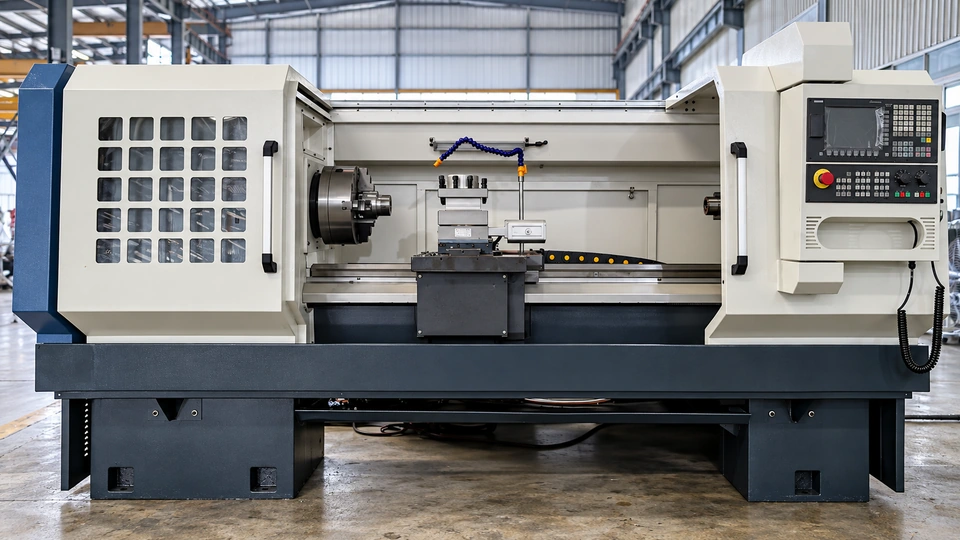
A CNC lathe is a machine tool that rotates a workpiece while programmed cutting tools remove material. On a basic two-axis machine, the tool moves along the spindle axis in Z and toward or away from it in X.
This arrangement suits round and rotationally symmetrical workpieces: straight or stepped shafts, pins, rollers, sleeves, rings, discs and tapered components. It can produce outside diameters, shoulders, grooves, threads and internal turned surfaces. A curved or stepped rotational profile can still be a turning job; a complex-looking drawing does not automatically require extra axes.
A two-axis lathe can also drill along the workpiece centerline with a stationary drill while the workpiece rotates. Sandvik Coromant describes this as non-rotating drilling. Therefore, a central hole in a shaft or sleeve does not by itself create a need for live tooling.
What is a turning center?
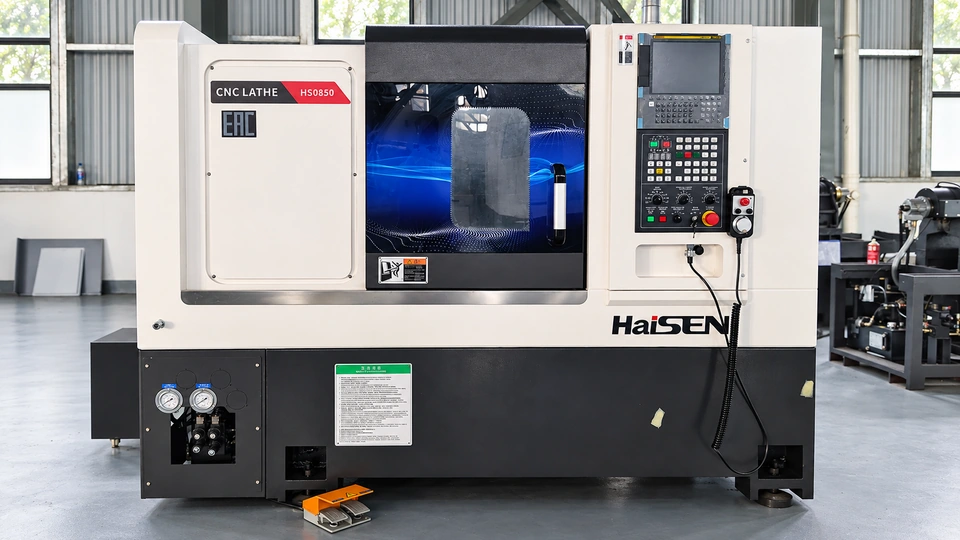
A turning center is a type of CNC lathe. The term commonly describes equipment with an enclosed work area, a multiple-tool arrangement and features for handling chips and repeated machining cycles. Depending on its configuration, it may perform turning alone or combine turning with milling, drilling and other operations.
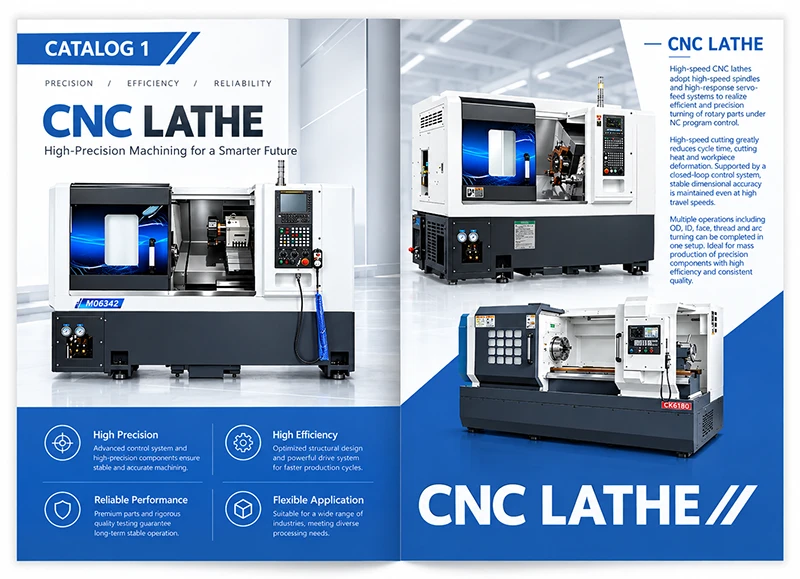
“Turning center” and “CNC lathe” overlap in actual machine naming. A turning center can be a two-axis machine, and a machine sold as a CNC lathe can have live tooling. For example, Hurco’s product-line description includes both two-axis and multi-axis turning centers. HAISEN’s own turning-center range also includes gang-tool, servo-turret, powered-tool and twin-spindle configurations.
Do not assume that a turning center includes a Y axis, a subspindle or milling capability. Check the exact model and option list. Equally, a servo turret that indexes to select another tool is not necessarily a powered turret that rotates the cutting tool.
Turning center vs lathe: key differences
The table below compares a basic CNC lathe with a turning center. It shows typical differences; live tooling, extra axes and a subspindle depend on the specific machine configuration.
| Comparison | Basic CNC lathe | Turning center |
|---|---|---|
| Main work | Turning, facing, grooving, threading, boring and suitable centerline drilling. | Turning, with milling or off-axis drilling available when suitable live tooling and axes are fitted. |
| Typical workpieces | Shafts, sleeves, pins, rings and other predominantly rotational parts. | Shafts, sleeves and other rotational parts; suitably equipped models can also machine cross-holes, face-hole patterns, flats and slots. |
| Tool system | Stationary cutting tools on a toolpost, gang-tool slide or indexing turret. | An indexing turret, with live tooling available on suitably equipped models. |
| Axis configuration | X and Z provide the basic turning motions. | X and Z, with C-axis control, Y-axis travel or other axes depending on the model and options. |
| Opposite-end work | Usually requires repositioning the workpiece in another setup. | When fitted with a suitable subspindle, the machine can transfer and hold the workpiece for second-end machining. |
| Automation | Bar feeding or loading automation may be available. | May combine part handling with several machining operations; the package must be specified. |
| Investment and operation | Fewer functions to purchase, program and maintain when turning covers the job. | Additional capability can reduce transfers and setups, but adds equipment, tooling and programming requirements. |
Neither name guarantees better accuracy, a shorter cycle or lower cost per part. Those results depend on the workpiece, the actual machine and the planned process.
When should you choose a turning-focused CNC lathe?
Choose a turning-focused CNC lathe when the required machining is mainly around one rotation axis and extra milling functions would do little useful work.
- Your workpiece is a shaft, pin or roller requiring cylindrical, stepped or tapered outside surfaces, shoulders or a threaded end.
- Your workpiece is a sleeve, bush or ring requiring turned outside and inside diameters, faces or circumferential grooves.
- Your workpiece needs a hole along its centerline that a suitable stationary drill and boring tool can produce.
- Your production consists of repeated turning work. A straightforward CNC configuration can remain appropriate for large batches; batch size alone does not create a need for live tooling or a Y axis.
For example, a stepped shaft with a central bore and an external thread can be a turning-focused job. Adding a cross-hole or a milled keyway changes the process requirements, even if the shaft’s main shape stays the same.
Large or long rotational workpieces may lead you to compare flat-bed CNC lathes with other turning layouts. The deciding factors are usable diameter and length, workpiece support and cutting demands. The bed shape or the label on the enclosure does not settle that choice.
When do additional turning-center capabilities make sense?
Additional capabilities make sense when your turned workpiece needs features that a basic X/Z turning setup cannot complete, or when bringing those operations into one machine offers a practical production benefit.
Cross-holes, face-hole patterns and milled flats
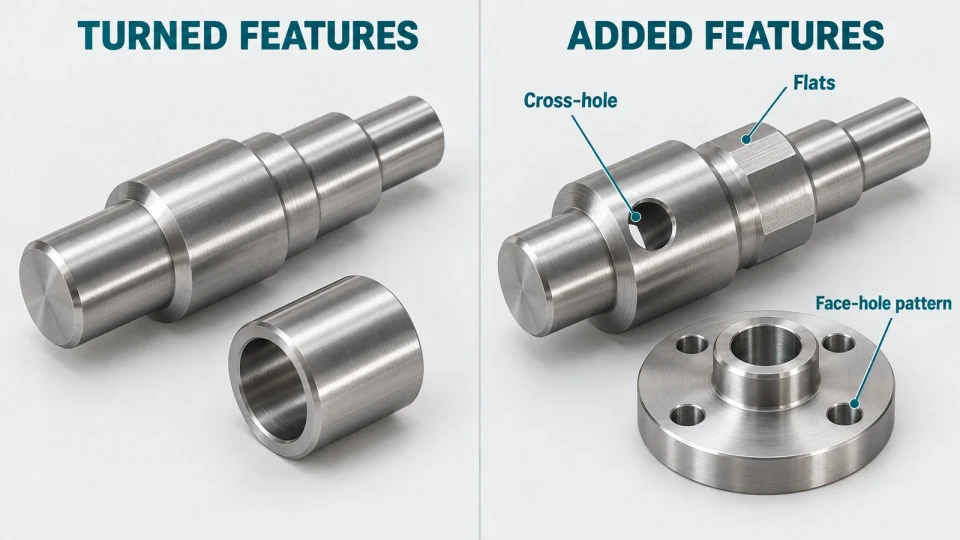
A shaft with a cross-hole, a flange with holes spaced around its face, or a round component with wrench flats needs more than ordinary turning. If you want to produce those features while the workpiece remains in the turning machine, specify suitable live tooling and control of the workpiece’s angular position.
Live tooling rotates the cutting tool; the C axis controls the workpiece angle. A hole at a fixed angular position may need the spindle indexed and held for cutting. A contour that requires the workpiece to turn in coordination with linear tool movement needs appropriate C-axis interpolation. Confirm which function the offered machine supports; “spindle orientation” alone is not a complete milling specification.
The guide to live tooling and axis functions explains these motions in more detail. For selection, the immediate task is to mark each cross-hole, flat, slot and face-hole pattern on the drawing and confirm the required tool orientation and reach.
When is Y-axis travel useful?
Consider Y-axis travel when the tool needs to move perpendicular to the normal X/Z turning plane to reach or machine a feature. An offset slot, an off-center pocket or a feature that needs controlled cutter movement across the part may make Y-axis capability useful.
Not every off-center feature requires a Y axis. Some face-hole patterns and contours can be produced with X/C motion, suitable live tools and control functions. The C-axis interpolation explanation in the Haas operator’s manual illustrates this distinction. Have the proposed toolpath checked for the exact feature, including travel limits and tool clearance, before adding or omitting a Y axis.
Opposite-end machining and a subspindle
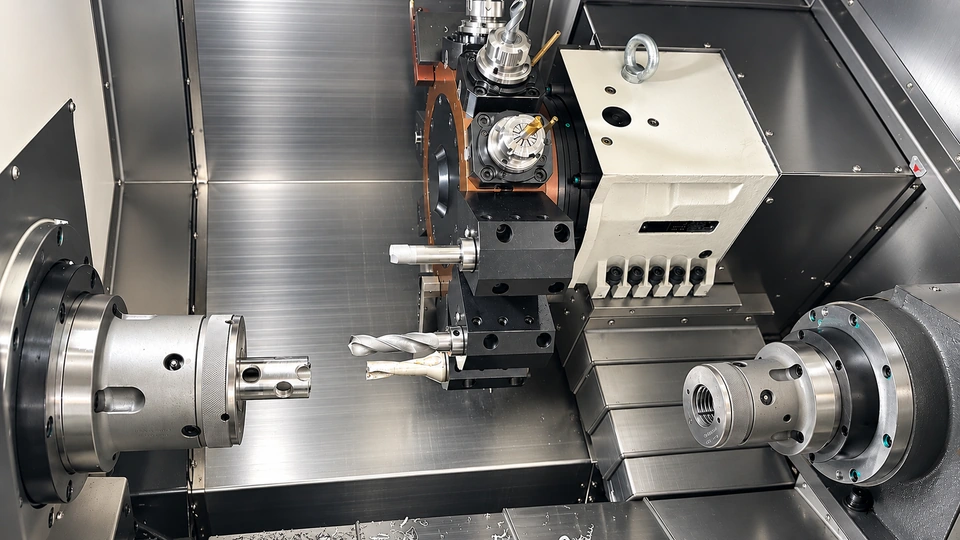
Consider a subspindle when the workpiece must be transferred to expose its second end for further machining. A bar-fed component may need its rear face finished or a rear bore machined after parting off. A suitable receiving spindle can hold it for those operations inside the same machine.
A subspindle and a tailstock do different jobs. A tailstock supports the workpiece during machining; it does not replace a receiving spindle for gripping and machining the second end.
Transfer to the subspindle is a new gripping operation. Completing a part in one machine does not mean every feature is cut in one unchanged clamping. Confirm the available gripping surface, transfer clearance and access to the rear features. The second spindle also needs suitable tooling and any required angular control for its assigned work.
How do you choose the right configuration for your part?
Start with the operations on the drawing, then check whether the proposed machine can reach them and whether the complete production route suits your workload.
List the operations on the drawing
Separate the features into three groups: turned surfaces and centerline holes; features requiring rotating tools or angular positioning; and features on the opposite end. This prevents a long option list from obscuring the actual machining requirement.
For each feature, ask the supplier to identify the tool, holder, machine motion and setup used. For a shaft with a keyway, for example, establish whether the proposed slot will be milled on the turning machine or on a separate mill. A statement such as “milling available” is not a complete answer.
Ask which features remain unfinished after the proposed cycle. This is especially useful for deep recesses, angled holes, inaccessible surfaces or work that requires a later finishing process. A complex drawing may still need another machine even with live tooling and extra axes.
Check usable space and tool access
Check the workpiece together with the chuck jaws, holders, tools and support equipment. Maximum swing, advertised turning diameter and usable cutting space describe different constraints. A part may fit inside the enclosure while a long driven holder cannot approach a particular feature.
For the actual configuration, confirm:
- The available turning diameter and length with the selected workholding and tailstock or subspindle.
- The driven-tool power, torque, speed and holder orientation needed for the cut.
- The Y-axis travel and C-axis functions required by the proposed toolpath.
- Clearance between tools, adjacent stations, chuck jaws and the workpiece throughout the cycle.
Request a layout or toolpath review, followed by trial machining where needed. Agree how critical dimensions, surface finish and the relationship between features will be measured. Catalogue positioning figures do not by themselves establish the finished part’s accuracy.
Compare the complete production route
Compare a turning-only machine followed by a separate drilling or milling operation with a suitably equipped turning center. Include loading, transfers, re-clamping, cutting, tool changes, inspection and batch setup time.
Integrated machining can be valuable when frequent transfers consume operator time or maintaining relationships between features is difficult. A separate mill can still make sense when the shop already has suitable capacity, the extra operation is occasional, or substantial milling would occupy the turning spindle for too long. Two machines may also cut different workpieces at the same time. On a single-turret machine, several cutting operations must share that turret, so check which tasks can overlap in the proposed cycle.
For small, varied batches, programming and setup effort can be important. For repeat production, handling time, tool life and the operation that limits output deserve closer attention. Ask for a cycle breakdown based on your workpiece, rather than a general claim that more axes mean faster production.
Compare quotations with the same scope: machine, driven holders, control options, workholding and required automation. The CNC lathe prices and startup costs guide covers the wider purchase budget. Here, the goal is to determine which additional functions will actually be used and what they change in your production route.
Frequently asked questions
Can you add live tooling to a basic CNC lathe later?
Sometimes, but it is not a simple toolholder change. The machine may need a compatible driven turret, spindle positioning, drives, wiring and control options. Ask the manufacturer which upgrades the exact model supports and which must be ordered with the machine.
Does a turning center automatically produce more accurate parts?
No. Finished-part accuracy depends on machine condition, thermal stability, workholding and tooling. Check critical dimensions using an appropriate measurement method.
Does bar feeding require live tooling?
No. Bar feeding supplies material to the work spindle; live tooling rotates a cutting tool. A compatible turning-only machine can use a bar feeder. Check the machine interface, workholding, permitted bar size and length, and the required part-removal arrangement.
Is a turning center the same as a machining center?
No. A turning center is built around rotating the workpiece for turning. A machining center is generally built around a rotating cutting-tool spindle for milling and related work. Their capabilities can overlap, but a turning center with live tooling does not automatically replace a machining center for every milling job.
Conclusion
The turning center vs lathe decision comes down to the specified configuration. A turning-focused CNC machine suits shafts, sleeves and other workpieces whose main features are produced around one axis. Live tooling, appropriate C-axis control, Y-axis travel and a subspindle become useful when the drawing and production route call for their particular functions. The machine’s name alone cannot confirm them.
If you are comparing these configurations, HAISEN can help connect the features on your drawing to a suitable machine and tooling arrangement. Our CNC turning center configurations include different tool systems and spindle layouts, so the discussion can start with the work your parts require. Share your machining requirements to compare a turning-focused option with the additional functions that would serve your application.