When you budget for a CNC lathe, the advertised machine price is only part of the decision. Size, tooling and machining functions can change the quotation, while delivery and startup add separate expenses. This guide compares public prices for different machine classes, explains new-versus-used costs and shows you how to work out the budget for bringing a suitable machine into production.
How much does a CNC lathe cost?
For a concrete budget reference, the Chinese supplier listings below show US$5,800 for a basic flat-bed model and US$16,200 for a slant-bed model. Other configurations and larger machine series carry higher advertised prices. Start with an example that matches your machining needs, then establish the price of the exact configuration and delivery scope you require.
Chinese supplier price examples
These Made-in-China supplier listings were checked on October 27, 2026. Prices are in US dollars at the quantities shown. They are individual advertised examples, not HAISEN quotations or a market-wide price range.
| Supplier and machine | Advertised price (USD) | Configuration and price scope |
|---|---|---|
| Shandong Matsumoto CK6140×750 Flat-bed CNC lathe | US$5,800 per machine For 1–4 machines | The standard-equipment table lists GSK control, a manual chuck and tailstock, and a four-station toolholder. Another field says eight stations; confirm the actual build. |
| Shandong Matsumoto TCK50 Slant-bed CNC lathe | US$16,200 per machine For 1–9 machines | The listing describes GSK control, hydraulic chuck and tailstock, and an eight-station hydraulic turret. Its specification table says TCK50A; confirm the variant and options. |
| Zhejiang Kaida DS28-O series Slant-bed CNC lathes | US$33,784–37,811 per set Minimum order: 1 set | The series includes 500, 1000 and 1500 mm cutting-length variants with a 12-station hydraulic turret. The advertised range is not assigned to individual variants. |
The two Matsumoto listings also offer lower unit prices for larger orders; the table uses the tier available when buying one machine. A hydraulic turret does not by itself establish that live tooling or a Y axis is included.
These are China-origin export listings, with no destination-specific delivered price confirmed. None clearly assigns the displayed price to a named EXW, FOB or other delivery term. For delivery to your country, obtain a written configuration and trade term, then confirm freight, import charges, local delivery and installation.
Other manufacturer price references
For additional context, Haas displayed the following US-dollar starting prices on October 27, 2026. These models have different capacities and equipment packages from the Chinese examples above; compare the specifications and support scope before comparing the prices.
| Machine class | Haas model and public starting price | Machine type or verified feature |
|---|---|---|
| Compact production turning center | Haas ST-10: $64,995 | Compact turning center with a 6.5-inch chuck and 44 mm bar capacity. |
| Dual-spindle Y-axis turning center | Haas DS-20Y: $163,995 | Dual spindles, a Y axis, C-axis functions and live tooling in one turning-center model. |
Confirm the final options, tooling package and regional quotation for each model. The difference between these two prices is not the standalone cost of adding a second spindle or a Y axis.
At a much smaller scale, TAIG lists its 4029 DSLS desktop CNC lathe at $3,895. That explains why searches can also return prices of only a few thousand dollars. A desktop package should not be treated as an alternative to an industrial turning center without checking workpiece size, cutting requirements and production needs.
Start with the class of machine that can produce your workpieces. Then compare quotations within that class. Comparing a small desktop lathe with a production machine tells you little about whether either quotation is good value.
Key Factors That Affect CNC Lathe Prices
CNC lathe prices depend on usable capacity, machining functions, the equipment supplied, the manufacturer and the support required to put the machine into production.
Machine brand and manufacturer
Brand can affect a CNC lathe’s price because manufacturers target different applications and invest differently in machine design, component selection, assembly and quality control. A model developed for demanding continuous production may carry different costs from one intended for general workshop use. Brand reputation and market positioning can also influence pricing, so check what you receive for the extra money.
The support behind the brand can also contribute to the price. A manufacturer with dealer technicians, stocked spare parts and training facilities may have different overheads from a supplier relying mainly on remote support. Check which services are actually available in your country, how replacement parts are supplied and which charges are separate. Compare the specific machines and packages: a higher price is worthwhile when the equipment or support offers value for your production needs.
Workpiece size, spindle capacity and workholding
A long shaft, a large flange and a small bar-fed component need different machine arrangements. Compare the actual turning diameter and length, bar capacity, spindle characteristics, chuck and support equipment against your drawings.
A quoted maximum swing is not automatically the diameter you can cut with your chosen tool, chuck and fixture. Likewise, bar capacity and maximum turning diameter are different specifications. Ask the supplier to confirm that the proposed setup accommodates the blank, the finished part and the tools together.
When comparing flat-bed CNC lathes, check whether a longer bed, a different chuck, a tailstock or a steady rest is necessary for your workpieces. Buying extra capacity that your production does not use increases the investment without necessarily improving the result.
Turret, live tooling, C axis and Y axis
A shaft that needs outside turning, grooves and an axial bore may suit a straightforward turning configuration. A shaft with cross-holes or milled flats can require additional machining operations, which may justify live tooling or a separate milling setup.
Live tooling rotates the cutting tool; C-axis functions control the work spindle’s angular position or motion; a Y axis adds another direction of linear movement. Their roles differ. The right combination depends on the feature, tool access and machining method. Our explanation of how live tooling works can help you identify which functions your parts actually require.
Ask whether the quotation includes the appropriate driven-tool holders, collets, cutting tools and control functions. A machine described as “live-tooling capable” does not by itself tell you which of those items will arrive with it.
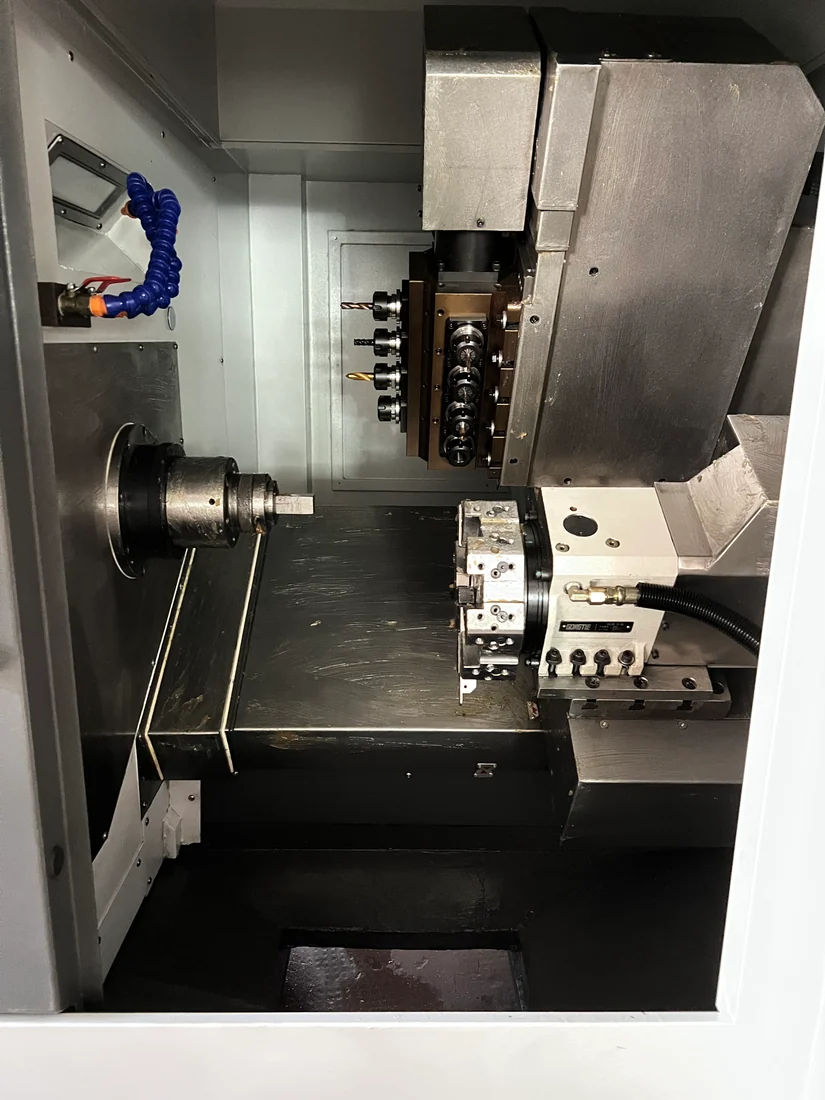
Control, automation, inspection and support
The control model, enabled functions and programming needs affect both the quotation and operator preparation. A bar feeder, parts catcher or second spindle can also change the process, but each needs to fit the workpiece, batch size and handling method.
Compare the supplier’s inspection and acceptance scope as well. If your purchase depends on a critical diameter, surface finish or cycle time, agree on the representative part, material, setup and measurement method. A controller brand or a higher purchase price does not prove that the finished workpiece will meet your requirements.
Is a used CNC lathe cheaper overall?
A used CNC lathe can have a lower purchase price, but compare the cost of bringing it into reliable production. Condition, included accessories, control support and repair needs can change the result.
For a concrete reference, Machinery Exchange listed a 2013 Haas ST-10 with tailstock at $27,000 and a 2016 ST-10 at $29,000 when its used CNC lathe inventory was checked on October 27, 2026. These are individual US-seller asking prices, not completed sale prices or a general depreciation rule. The machines have not been independently inspected for this guide.
Before comparing a used machine with a new quotation, establish:
- Mechanical and operating condition: request maintenance history and a suitable inspection of the spindle, axes, lubrication, turret and coolant system. A machine powering on is only the beginning of the assessment.
- Evidence from machining: where practical, arrange a representative cutting test and inspection of the resulting part. Agree who performs the test and what counts as acceptance.
- What comes with the machine: list the chuck, jaws, holders, driven tools, manuals, software rights and control backups that are actually included.
- Costs before production: include disconnection, loading, transport, unloading, installation and any identified repairs or replacement accessories.
- Support and downtime exposure: check spare-parts availability, service options and the seller’s actual warranty terms. Neither “new” nor “used” establishes those terms by itself.
A used machine is most attractive when its condition is well established, its configuration matches your work and local support is available. For a first CNC installation, uncertainty about repair and commissioning can matter as much as the purchase-price saving.
What should your total purchase and startup budget include?
Your startup budget should cover the selected machine, delivery to its operating position and everything required for the first accepted production run. Keep ongoing operating costs in a separate forecast.
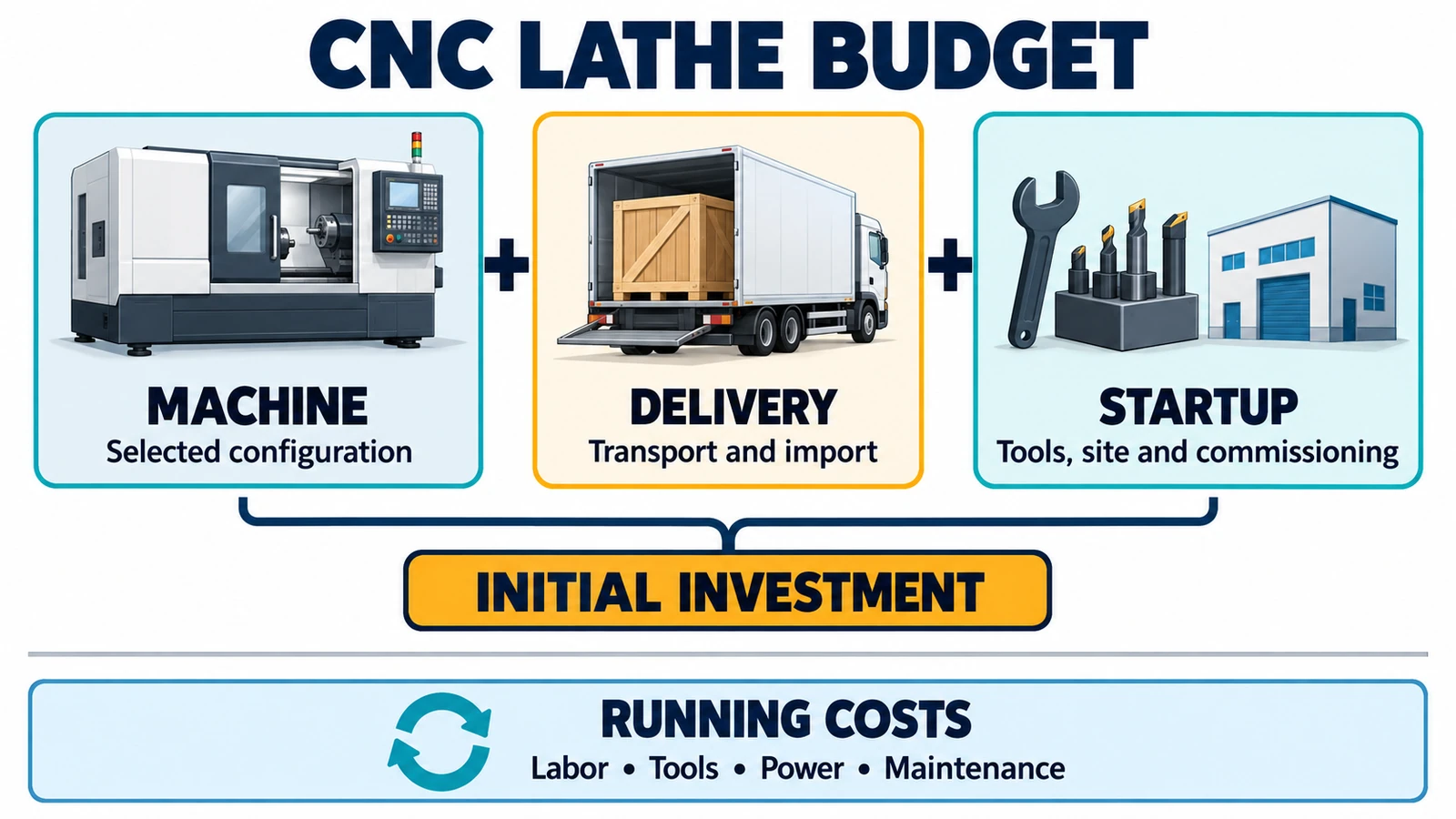
| Budget item | What to confirm | How to record it |
|---|---|---|
| Configured machine | Model, control, spindle, turret, chuck, required axes and selected options | Supplier price for the agreed configuration |
| Tooling and workholding | Holders, inserts, drills, boring bars, collets, jaws and fixtures for the first jobs | Included items plus the cost of missing items |
| Packing and transport | Export packing where needed, loading, freight, insurance and the agreed delivery point | Quoted scope and the party responsible for each stage |
| Import and local delivery | Brokerage, applicable duties and taxes, destination charges, inland transport and unloading | Destination-specific estimates from the relevant providers |
| Site preparation | Access route, floor and foundation requirements, electrical supply and any specified air or other utilities | Site-specific preparation and connection costs |
| Commissioning and first production | Installation, training, programming, trial material, initial fluids and inspection equipment | Included services, separately priced services and your own preparation costs |
For each row, mark included, extra or not applicable, name the responsible party and enter the amount in one budget currency. Do not add an item twice because it appears in both the machine quotation and a freight or installation package.
Startup budget = configured machine price + additional delivery and import costs + additional tooling and site preparation + additional commissioning costs. Add a separate allowance for identified uncertainties, based on the risks in your project rather than an arbitrary universal percentage.
For an imported machine, agree on the delivery term and named place in writing. Ask your freight provider and customs broker to price the uncovered stages for your actual destination. There is no single freight or tax percentage that works for every buyer in Brazil, Vietnam or another market.
Then forecast recurring costs such as operator time, cutting tools, coolant, power, maintenance, software subscriptions where applicable and expected downtime. If financing is involved, keep the payment schedule and financing charges visible without counting the machine principal twice.
How do you compare CNC lathe quotations fairly?
Send suppliers the same workpiece and production requirements, then compare the equipment and delivery scope line by line. Two quotations labelled “CNC lathe” can contain substantially different packages.
| Comparison point | Ask each supplier to state |
|---|---|
| Workpiece and output | Material, blank size, finished drawing, critical tolerances, batch size and target output used for selection |
| Usable capacity | Turning diameter and length with the proposed setup, bar capacity and required workpiece support |
| Machine configuration | Exact model, control, spindle, turret, chuck, axes and enabled functions |
| Tools and accessories | Itemized quantities of holders, jaws, driven tools and other accessories; distinguish installed hardware from “ready for” provisions |
| Acceptance | Agreed checks, trial part and material, measuring method, reports and any cycle-time conditions |
| Delivery and startup | Packing, named delivery point, transport responsibility, installation, training and site obligations |
| Commercial terms | Currency, quotation validity, payment schedule, delivery schedule, warranty scope and separately charged services |
If one quotation is cheaper, identify the specific difference before deciding. It may be a suitable simpler configuration, or it may omit the tooling, support or delivery stage included elsewhere. Ask for a revised comparison with the missing items priced.
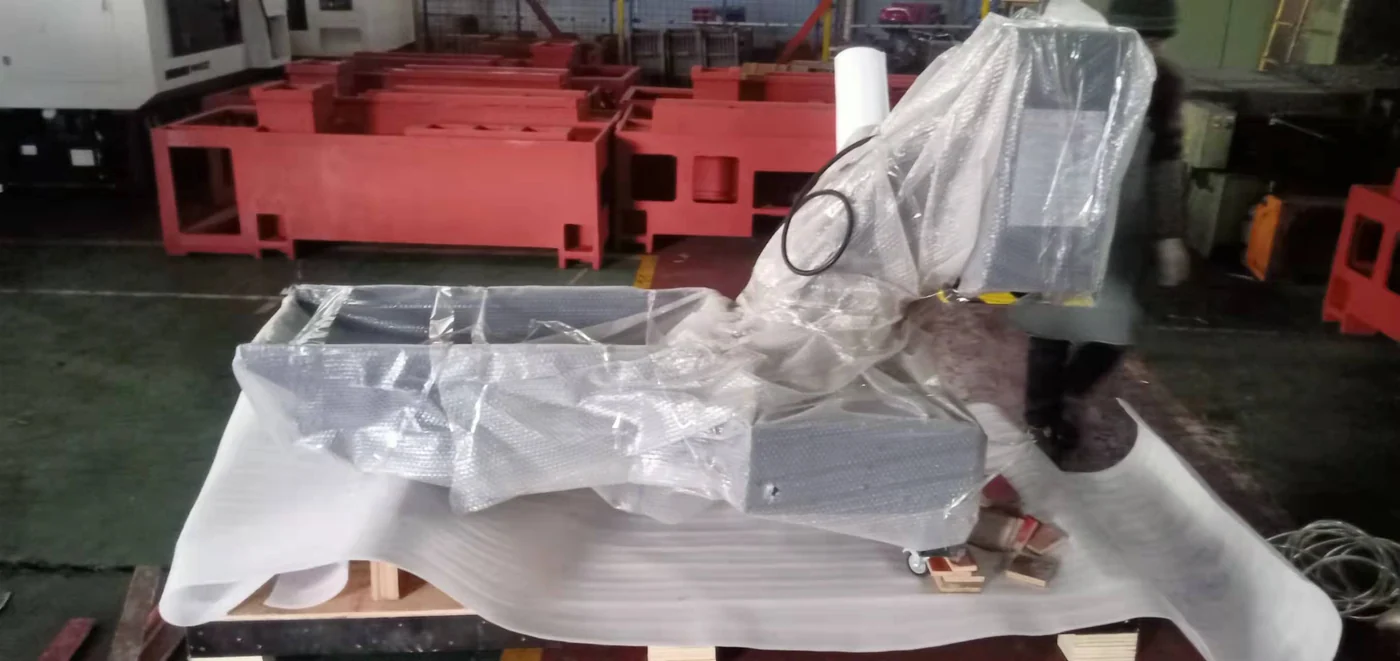
Keep the final configuration list attached to the agreed quotation. If you later change the controller, chuck, tooling package or automation, request a dated revision showing both the specification change and its price effect.
When is a more expensive CNC lathe worth buying?
A higher price is justified when the added capability is necessary for your workpieces or produces enough measurable benefit to cover its additional cost.
For example, a production run of shafts with only turned diameters and axial holes may not benefit from paying for a Y axis. A part with cross-holes, flats and work on both ends may benefit from combined machining, provided the proposed machine can reach every feature and the process is proven. Frequent short batches also need a different automation calculation from long runs of the same component.
Compare the additional investment with the annual net benefit. Include the time saved on handling and second setups, but subtract extra tooling, programming, maintenance and other operating costs. Use realistic output and usable capacity rather than assuming the machine will run continuously.
As a purely illustrative calculation, an option package costing an additional $20,000 with an expected net benefit of $8,000 per year has a simple payback of 2.5 years. Those figures are assumptions, not equipment quotations or a promised return. The calculation excludes financing, tax, residual value and the timing of cash flows; replace the assumptions with your own process data before making a purchase decision.
If the workload is uncertain, compare a simpler machine plus selected outsourced operations with the more capable machine. The lowest purchase price is not always the lowest production cost, and the most complex machine is not always the best use of the budget.
Frequently asked questions
Does “bar-feeder-ready” include a bar feeder?
Not necessarily. It may describe machine provisions or an interface rather than the feeder itself. Ask the supplier to list the feeder model, interface, installation and any required liners or support equipment separately, and confirm compatibility with your bar sizes.
Can you buy a basic machine now and add live tooling or a Y axis later?
Do not assume those upgrades are practical. They can depend on the machine structure, turret drive, spindle control, wiring and software. Ask the manufacturer which upgrades are supported on the exact model, what must be ordered at the factory and what a later installation would require.
Why can the final quotation differ from the website price?
A website may show a starting configuration, a particular inventory machine or a limited offer. Your selected options, delivery scope and local costs may differ. Request a dated written quotation that identifies the currency, included items, exclusions and validity period.
Should you compare monthly payments or the purchase price?
Compare both, for different purposes. The complete purchase and startup budget shows the investment required; the payment schedule shows the cash-flow commitment. When comparing financing proposals, use their actual deposits, term, charges and final-payment conditions rather than the advertised monthly amount alone.
Conclusion
CNC lathe prices vary because the machines differ in size, machining capability, configuration and condition. Use public model prices to establish the scale of investment, then compare quotations for the equipment your workpieces require. Include delivery, tooling and startup costs before deciding which offer fits your budget.
If you are comparing CNC lathe prices, a quotation matched to your workpieces can help you judge which options fit your budget. HAISEN supplies CNC lathes and CNC turning centers, with configuration advice based on your machining needs. You can request a quotation that clearly lists the included equipment and services, making it easier to compare offers and plan your purchase.